
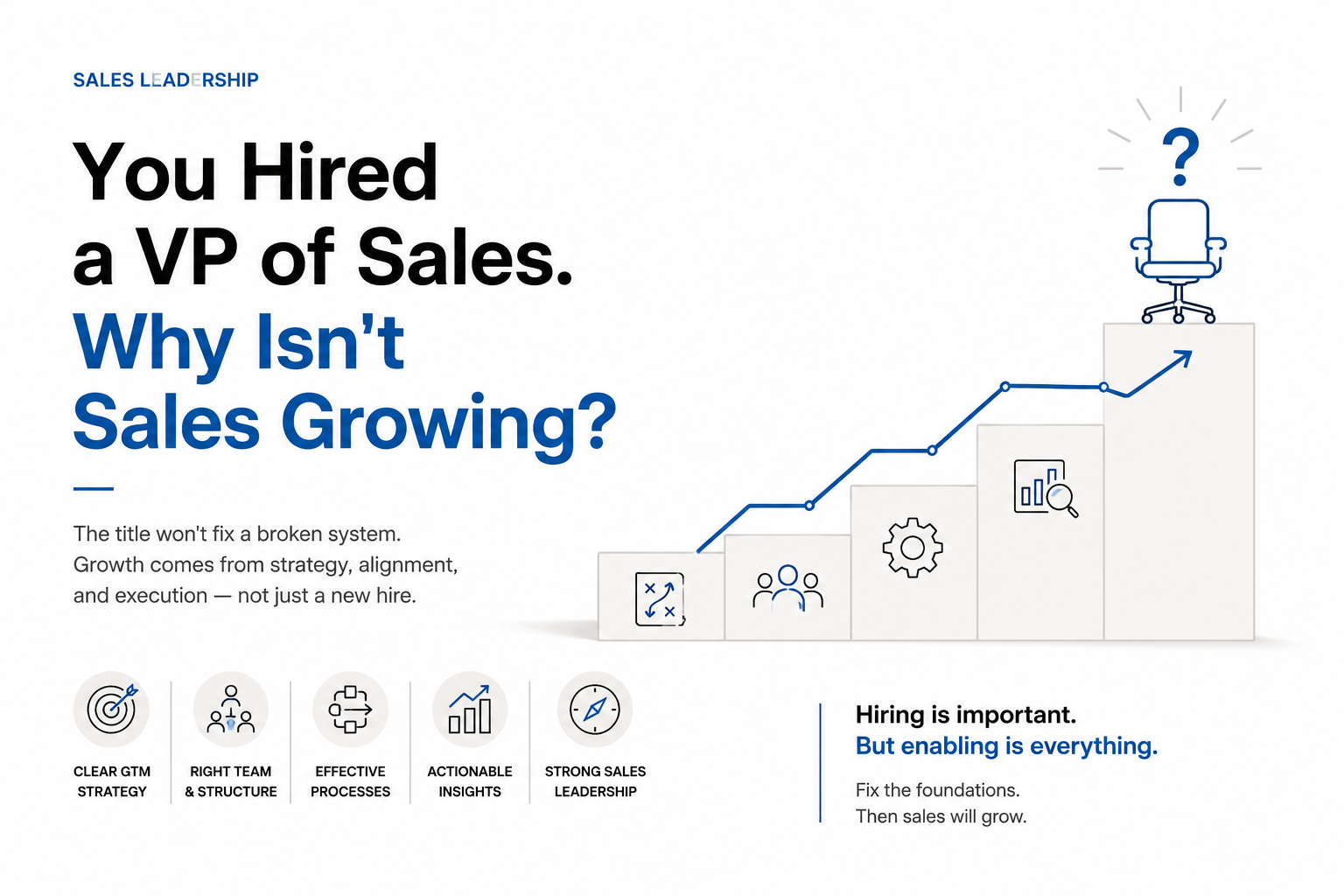
For many technical founders, the journey starts with a great product.
You identify a real problem. You build a solution. You find early customers. You receive positive feedback. A few customers convert. The founder-led sales motion starts working.
Then comes the next big question: “How do I scale sales?”
The answer often seems obvious: “Let’s hire a VP of Sales.”
It sounds logical. The founder can focus on product, technology, fundraising and strategy. The VP of Sales can take ownership of revenue and build the sales organization.
But there is a problem that many early-stage companies discover too late.
A VP of Sales can scale a sales engine. But if the sales engine is not yet proven, the VP of Sales may end up spending most of their time trying to build the engine itself.
And that is where the founder-VP relationship can start going wrong.
The VP of Sales Is Hired With a Big Expectation
The founder expects the new VP of Sales to deliver.
Build the team. Generate pipeline. Create predictable revenue. Close enterprise deals. Improve conversion. Build sales processes. Establish CRM discipline. Create sales playbooks. And, of course, hit the revenue target.
All of this is expected to happen quickly.
But the VP soon discovers that the reality is different.
The ICP may not be clearly defined. The positioning may need refinement. The messaging may not resonate consistently. The sales process may exist only in the founder’s head. The CRM may contain incomplete or unreliable data. There may be no repeatable lead generation engine. The sales cycle may be longer than expected.
And the founder’s early customers may have been acquired through personal relationships, networks or founder credibility that cannot easily be replicated.
They were hired to scale sales, but they first need to figure out what actually works.
The Hidden Problem: The VP Becomes a High-Paid Lead Generation Executive
This is one of the most common mismatches.
A company hires a VP of Sales because it needs leadership. But because the sales engine is not mature, the VP ends up doing everything.
- Prospecting
• Lead generation
• Cold outreach
• Account research
• Sales calls
• CRM updates
• Pipeline reviews
• Hiring
• Training
• Strategy
• Forecasting
• Closing
Instead of building a sales organization, the VP becomes the most expensive person in the organization doing activities that should eventually be handled by a structured sales and marketing system.
The founder starts asking: “Why isn’t the VP generating enough leads?”
The VP starts thinking: “Why am I doing lead generation instead of leading sales?”
Both sides may be right. And both sides may be wrong.
The real problem is often that the company hired a sales leader before building a sales system.
The 3–6 Month Settling Period
A senior sales leader needs time to understand the business.
They need to learn the product, market, ICP, buyer, competition, sales cycle, value proposition, pricing, objections and buying process.
This learning period can easily take several months.
But the company is also under pressure. The founder may have raised investment. The board may expect growth. The revenue target has already been set. The sales team is waiting for direction. The pipeline needs to grow. The VP is under pressure to deliver.
The result is an uncomfortable contradiction.
The company needs the VP to build the foundation. But the company expects the VP to deliver results immediately.
The Founder-VP Expectation Gap
The founder thinks: “I hired an experienced VP. I should now be able to step away from sales.”
The VP thinks: “I need time to understand the business and build the sales engine.”
The founder thinks: “We need more pipeline.”
The VP thinks: “We need better positioning and lead generation.”
The founder thinks: “Why aren’t you hitting the numbers?”
The VP thinks: “The numbers were unrealistic because the sales model wasn’t validated.”
The problem is not necessarily a bad founder. The problem is not necessarily a bad VP.
The problem is often timing and readiness.
The 12-Month Test
After 9–12 months, the company may reach a difficult decision.
The founder feels the investment has not produced the expected outcome. The VP feels they were given unrealistic expectations. The board wants accountability. The founder wants results. The VP wants more time.
Eventually, one of two things happens. The VP leaves. Or the company asks the VP to leave.
And then the founder is back to where they started.
Except now 12 months have passed, significant money has been spent, sales momentum may have been lost, the team may have changed, market learning may not have been documented, and the founder may have to start the hiring process again.
The company has lost not just money. It has lost time.
And for an early-stage startup, time is often the most expensive resource.
So, Should You Not Hire a VP of Sales?
Not necessarily. A VP of Sales can be extremely valuable.
But the question is: When should you hire one?
If the company already has a defined ICP, validated value proposition, repeatable sales process, predictable pipeline mechanism, working CRM, clear sales stages, sales playbook, defined KPIs and a proven sales motion, then the VP of Sales can focus on what they are best positioned to do: scale.
Build the team. Improve productivity. Increase conversion. Expand markets. Drive predictable revenue.
But if these foundations do not exist, the company may need a different approach.
The Question Founders asking “Should I hire a VP of Sales?“
Instead Ask: “Do I have a sales system that a VP of Sales can actually scale?”
If the answer is no, the priority should be to build and validate that system first.
This does not mean the founder needs to do everything alone. It means the company should first build the sales engine before putting a senior executive in charge of scaling it.