
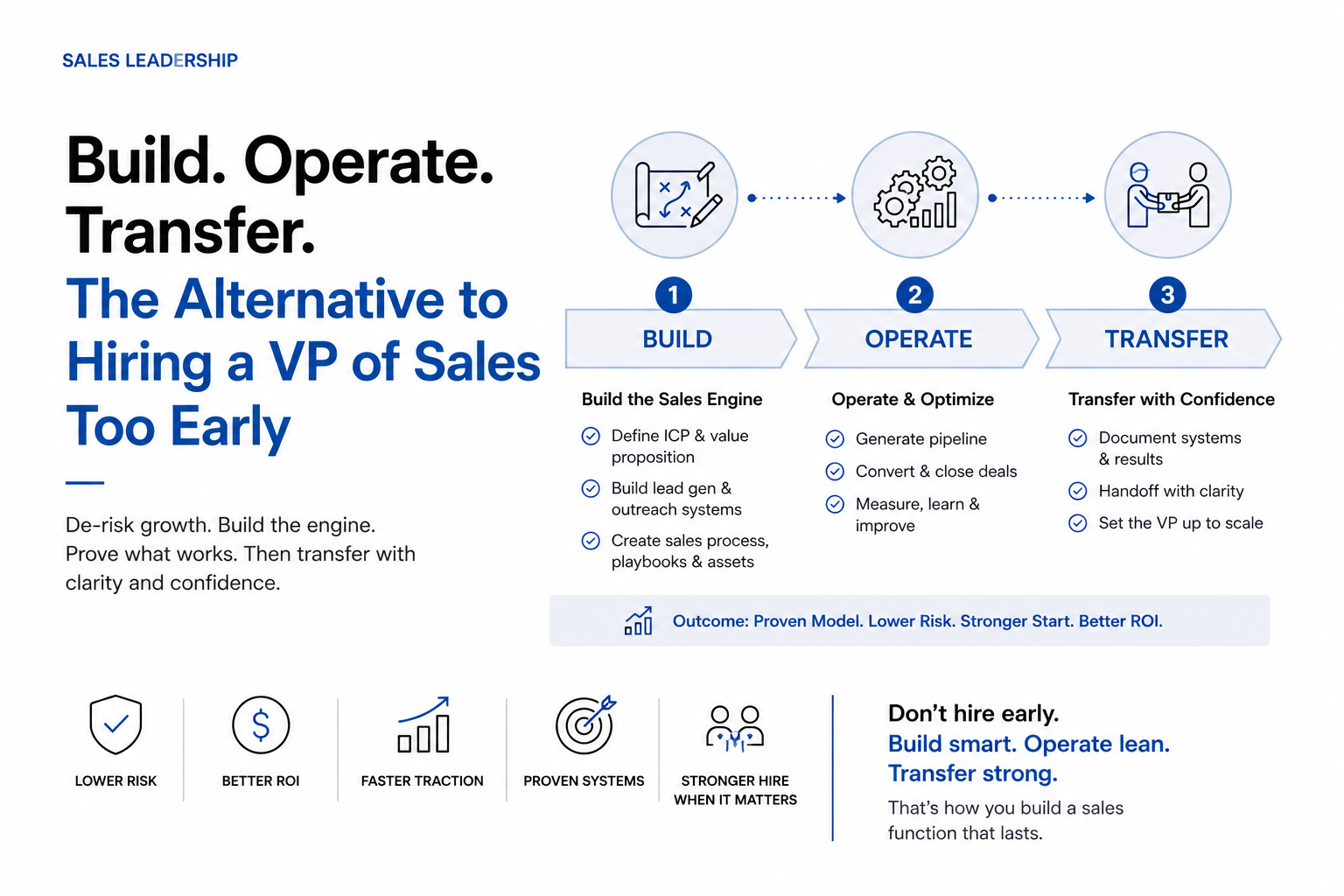
The Alternative to Hiring a VP of Sales Too Early
For technical founders, this is one of the most important questions to answer.
You have built the product. You have early customers. You have validated that people are willing to pay. Now you need growth.
The natural next step seems obvious: Hire a VP of Sales.
But what if your sales model is not yet repeatable? What if the founder is still the primary salesperson? What if lead generation is inconsistent? What if the ICP is still evolving? What if the sales process is not documented? What if you do not yet know which sales channels will scale?
Hiring a VP of Sales at this point may create a difficult situation.
The company expects the VP to deliver revenue. The VP needs to discover the sales model. The founder wants to step away. The VP needs the founder’s knowledge. The company wants predictable pipeline. The pipeline generation process is not yet predictable.
This is the dilemma.
But there is another way.
Build. Operate. Transfer.
The BOT Framework.
B – BUILD: Build the Sales Foundation With the Founder
The first step is to build the sales ecosystem.
Not in isolation. Not through a strategy presentation. But with the founder.
SM Mentors works alongside the founder to define and structure the commercial foundation.
- Ideal Customer Profile
• Target market
• Buyer personas
• Positioning
• Value proposition
• Sales messaging
• Sales process
• Qualification framework
• CRM
• Sales technology
• AI opportunities
• Sales KPIs
• Sales playbook
The founder’s experience is critical.
The founder knows the product. The founder knows the customer problem. The founder knows why the company exists.
Our role is to help transform that knowledge into a system that can eventually be transferred to a team.
The goal is simple: Turn founder knowledge into organizational knowledge.
O – OPERATE: Strategy Means Nothing Without Execution
This is where BOT is different from traditional consulting.
Many consultants deliver a strategy. SM Mentors helps operate it.
The sales engine is tested in the real world.
Prospects are identified. Outreach is executed. Leads are qualified. Sales conversations happen. Objections are captured. Pipeline is managed. Conversion is measured. The sales process is continuously improved.
The cycle becomes: Build → Execute → Measure → Learn → Optimize → Repeat
This is where the real value is created.
Sales strategy is not developed once. It evolves through market feedback.
You may discover that your original ICP was too broad. You may discover that one segment converts better than another. You may discover that your messaging needs to change. You may discover that the sales cycle is longer than expected. You may discover that a different buyer is more influential.
These insights are not failures. They are learning.
And BOT creates a structured environment to learn before scaling.
The Founder Learns While the Sales Engine Is Built
One of the biggest advantages of BOT is founder involvement.
The founder does not simply hand over sales and disappear. The founder participates in the journey.
This creates two outcomes. The company gets a sales engine. And the founder develops a deeper understanding of how that engine works.
The founder learns what customers value, what customers reject, why deals are won, why deals are lost, which messages work, which channels work, what objections occur and how long deals take.
This knowledge becomes extremely valuable when the company eventually hires its sales leader.
The founder can now ask better questions, set better expectations, define better KPIs and evaluate performance based on evidence rather than assumptions.
T – TRANSFER: Build It. Operate It. Then Transfer It.
BOT is not designed to create permanent dependency.
The objective is ownership.
Once the sales ecosystem becomes sufficiently structured and repeatable, SM Mentors helps transfer it to the company.
This could be a VP of Sales, Head of Sales, Revenue Leader or Internal Sales Team.
The new sales leader does not start from zero.
They inherit a validated ICP, defined positioning, sales messaging, a working sales process, CRM structure, sales playbooks, pipeline data, sales KPIs, AI workflows and market insights.
The new leader’s job becomes what it should have been from the beginning: Scale the sales engine.
Not discover it.
The Founder Gets Control-Not Dependency
A successful BOT engagement should leave the company stronger.
The company owns the data, CRM, process, playbook, technology, customer knowledge and sales ecosystem.
SM Mentors transitions from Operator to Strategic Growth Advisor.
The founder retains control. The organization gains capability. The sales leader gets a foundation. And the company is ready to scale.
BOT vs Hiring a VP of Sales Too Early
The difference is not about whether you should eventually hire a VP of Sales. It is about when.
Traditional approach: Hire VP → VP learns business → VP discovers ICP → VP builds process → VP generates pipeline → Founder expects revenue → Pressure increases → Results are evaluated
BOT approach: Build → Operate → Validate → Optimize → Document → Transfer → Scale
The second approach creates a different starting point for the sales leader.
When Is BOT Most Valuable?
BOT can be particularly valuable when:
The founder is still leading sales
• The company has early customers
• The product is ready for growth
• The ICP is still being refined
• The company wants to enter enterprise sales
• The sales process is founder-dependent
• Lead generation is inconsistent
• The company is not ready for a full-time VP of Sales
• The company wants to prepare for a senior sales hire
• The founder wants to retain control of the sales ecosystem